In this guide
A great many people come to Braj specifically to bring their parents — it is often a trip promised for years. And almost every guide available quietly assumes a visitor who can walk several kilometres over broken ground, climb unrailed steps barefoot, and hold their place in a dense crowd for half an hour.
This guide assumes the opposite. Nothing below is about doing less darshan; it is about spending the walking you have on the temples that repay it.
The three real obstacles
Distance from where the car stops
This is the one that catches families out. Several of the most important temples sit inside lanes no car can enter, so the distance that matters is not the drive — it is the walk from the drop-off, through a crowded bazaar, on uneven stone.
Barefoot on uneven ground
Footwear comes off before entering, and temple floors are stone: uneven, often wet near the entrance, and in summer hot enough in open courtyards to be genuinely painful. Thick socks help more than anything else and are permitted in most places.
The crush
At peak darshan the crowd does not queue so much as compress. For someone unsteady on their feet that is the real hazard of the trip — not the walking. The answer is timing, and it is a complete answer: the same darshan at a quiet hour is an entirely different experience.
Temple by temple: what the walk is like
| Temple | Walk from the car | Steps | Verdict |
|---|---|---|---|
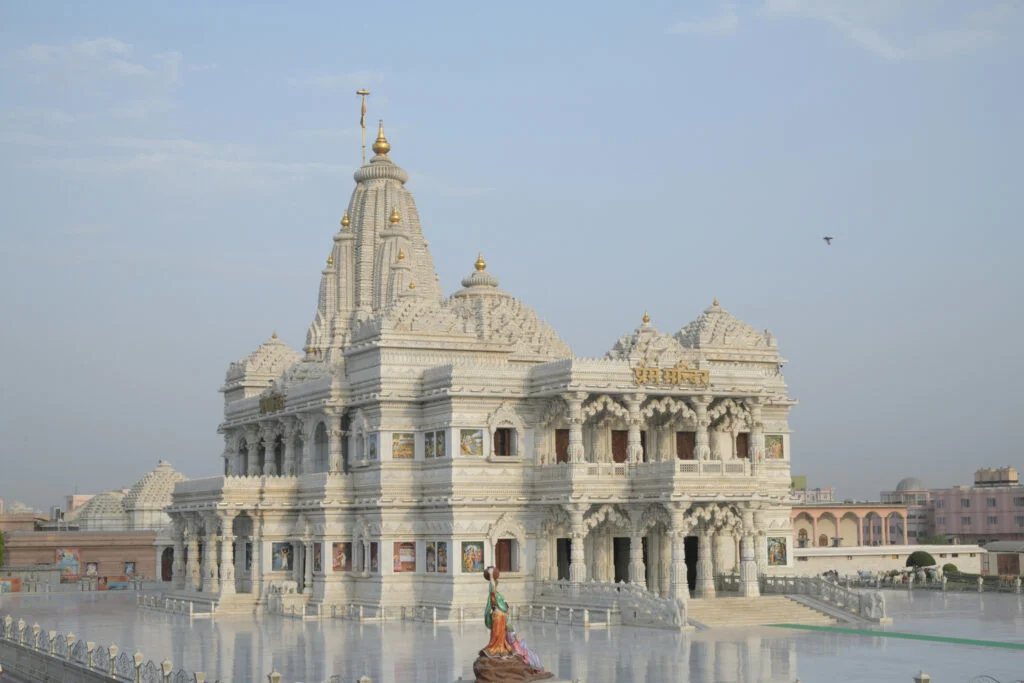
| Prem Mandir | Short, level, paved | Few, with ramps and railings | Easiest in Braj. Gardens and benches. Do this one. |
| ISKCON Vrindavan | Short and manageable | Some | Comfortable. Clean floors, orderly darshan. |
| Shri Krishna Janmasthan | Moderate, plus a security queue | Some | Doable, but the queue is long and there is nowhere to sit in it. |
| Dwarkadhish, Mathura | Moderate through market lanes | Some | Manageable outside peak hours. |
| Banke Bihari | Long, through a crowded bazaar | Steps at the entrance | The hardest of the essential temples. Go at opening, not at aarti. |
| Radha Raman | Moderate, narrow lanes | Some | Quieter than Banke Bihari and far gentler. |
| Nidhivan | Short | Uneven ground inside | Fine, but the grove floor is rough underfoot. |
| Govardhan parikrama | 21 km circuit | n/a | Not on foot. A vehicle parikrama is the sensible option. |
The monkeys are a real problem, not a charming detail
Vrindavan's monkeys take spectacles, phones and bags with practised skill, and they target older visitors because they are slower to react. Losing a pair of prescription glasses on day one of a four-day trip is a serious problem, and it happens constantly.
- Keep spectacles on a cord, or in a case until you are inside.
- Do not carry food or plastic bags in the open — both attract attention immediately.
- Nothing loose in outer pockets, and no phone held out at arm's length for a photograph.
- If something is taken, do not chase or pull back. Local shopkeepers will usually negotiate its return with a piece of fruit.
Timing the day so it is gentle
- Go at opening, not at aarti. The single most effective decision you can make — same darshan, a fraction of the crush.
- Two temples in the morning, two in the evening. Not six. The midday closure is a rest, and it should be spent resting.
- Visit between October and March if you have any choice. Summer heat on stone floors is the limiting factor for older visitors.
- Keep the car close and the driver reachable, so anyone who has had enough can sit down without ending the outing for everyone.
- Put Prem Mandir at the end of the day. It is level, lit, and has somewhere to sit.
Wheelchairs and assistance
A wheelchair works well at Prem Mandir and ISKCON, and poorly everywhere the approach is a bazaar lane — the surface, the crowd and the steps all defeat it. If someone in the group uses one, build the trip around those temples rather than trying to take it everywhere.
For the Govardhan parikrama, a vehicle circuit is entirely legitimate and widely done. It is not a lesser version of the thing; it is how a great many pilgrims complete it.
What to carry
- Thick socks — the single most useful item on this list.
- Water, and any regular medication, on the person who needs it rather than in the car.
- A folding stick or cane, if it is ever used at home. Uneven stone is not the day to go without.
- A cloth bag rather than a backpack — easier to keep in front of you in a crowd.
- Photocopies of ID, and the driver's number written on paper as well as saved in a phone.
Tell us who is travelling and we will plan the day around what they can comfortably walk — including where the car waits, and which temples are worth the effort on the day.