In this guide
Of everything that goes wrong on a first visit to Vrindavan, one mistake accounts for more wasted days than the rest combined: arriving at Banke Bihari in the middle of the day. The temple closes for several hours every afternoon. It is not a secret and it is not irregular — it is simply the way the day is structured, and it catches people who have driven 180 km from Delhi that morning without checking.
This guide sets out the pattern in both seasons, what the aarti sequence actually is, which hours are calmest, and the practical business of where a car can stop and how far you walk from there.
The midday closure is the whole story
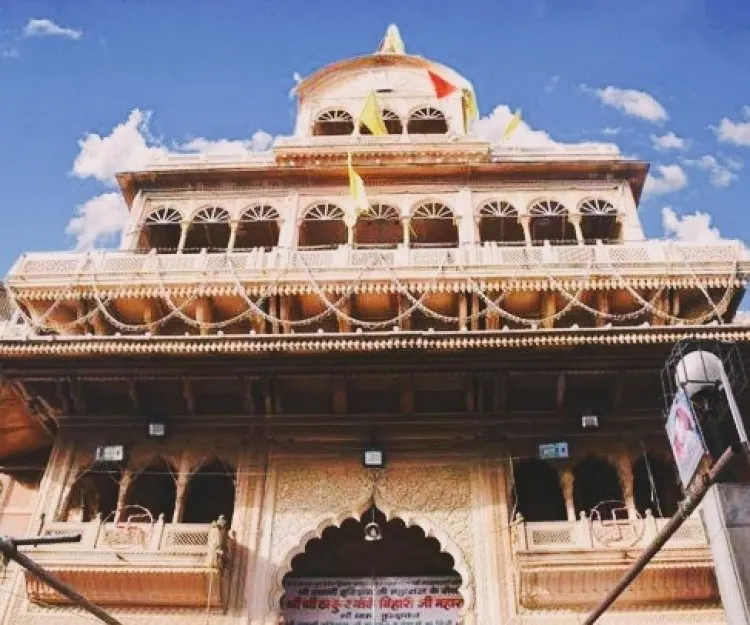
Banke Bihari runs two darshan sessions — a morning one and an evening one — with a long closure between them. The deity is offered rest in those hours, and the gates are shut. There is no queue to join and nothing to wait for; the lane outside empties out and the shops carry on without you.
The practical consequence is that a day in Vrindavan has two halves with a hole in the middle, and everything else you plan has to fit around it. That is not a problem — the closure is a good window for lunch, for Prem Mandir, or for the drive between Mathura and Vrindavan — but only if you know it is coming.
Summer and winter timings
The whole schedule slides earlier in winter and later in summer, tracking sunrise and sunset rather than the clock. Roughly, the changeover follows the seasons rather than a fixed date.
| Season | Morning session | Evening session |
|---|---|---|
| Summer (approx. April–October) | Around 7:30 AM – 12:00 noon | Around 5:30 PM – 9:30 PM |
| Winter (approx. November–March) | Around 8:45 AM – 1:00 PM | Around 4:30 PM – 8:30 PM |
Published sources disagree on the exact minutes, particularly on the evening closing time, which is why the table says "around". What every source agrees on — and what actually matters for planning — is the shape: mornings end around midday, evenings begin in the late afternoon, and the gap between them is several hours wide.
The aarti sequence
Three aartis punctuate the day, and they are the busiest and the most atmospheric moments to be present. Shringar aarti follows the morning opening, when the deity is dressed. Rajbhog aarti comes before the midday closure. Shayan aarti closes the evening session.
If you have one visit and you want the full experience rather than the shortest queue, time it to an aarti and accept the crowd. If you have elderly parents or small children with you, do the opposite — the quiet hour after an aarti is far easier and the darshan is no less real.
The calmest hours, and the days to avoid
- A weekday morning, close to opening, is reliably the calmest darshan of the week.
- Weekends are materially busier, and the lane outside becomes hard to move through.
- Janmashtami and Holi bring the largest crowds of the year. They are extraordinary to witness and a poor choice for a first, quick visit.
- October to March is the comfortable season for the walking that Vrindavan demands. May and June are punishing in the middle of the day.
Getting there, and where the car actually stops
Banke Bihari is roughly 12–13 km from Mathura Junction, which is about 30 to 45 minutes depending on traffic. From Delhi it is around 180 km in total, which realistically means three and a half to four and a half hours on the Yamuna Expressway.
The detail that surprises people: no car reaches the temple. The lanes around Banke Bihari are narrow, crowded and largely pedestrian, so vehicles stop at a distance and you walk the last stretch — through a busy bazaar, often for several hundred metres. E-rickshaws cover part of it. Plan for that walk when you are deciding what the day can hold, particularly if anyone in the group has trouble on their feet.
What to know before you go in
- Photography and videography are not permitted inside the temple.
- Dress modestly — shoulders and knees covered. Shorts are not appropriate for any temple in Braj.
- Footwear comes off before you enter; there are stalls outside that mind shoes for a small fee.
- Keep phones and wallets in a front pocket or an inside zip. The crush at darshan is genuine, and so is the pickpocketing.
- Monkeys in the surrounding lanes take spectacles and phones with real skill. Hold them, do not display them.
We time our Vrindavan itineraries around the current darshan hours rather than a printed schedule, and we check them on the morning of travel. Tell us the temples you want and we will build a day that reaches all of them while they are open.